
New Partnership Serves Kids with Special Healthcare Needs
Rutgers School of Dental Medicine (RSDM) has teamed up with Crossroads, a public school for children with autism spectrum disorder, to remove barriers to oral healthcare for students with high support needs.
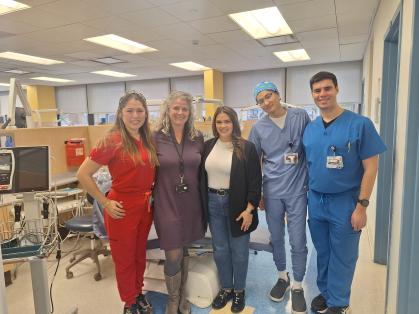
"Rutgers has been nothing but fabulous," said Alayna Quattrocchi, speech-language pathologist at Crossroads School, who spearheaded the partnership last academic year.
Parents often ask her where they can find dentists willing to treat children with special healthcare needs. "Even in 2025, we still have students that were turned away [for care]," she said. "We know that the disabled population, specifically those who have high support needs, have the poorest oral health, and that poor oral health leads to poor overall health."
Married to a Rutgers-trained dentist, Quattrocchi teamed up with RSDM to create a solution. The school's Brunsden-Villa Pediatric Dental Center, a premier teaching facility, offers preventive care for children and patients with special needs. So far, Crossroads students have visited RSDM four times for screenings and cleanings, with more planned.
"Eighty percent of our students have been seen already, and they've been very successful," said Quattrocchi. "We really look forward to expanding our relationship."
For Quattrocchi, the collaboration is about more than dental care—it's about trust. "We're building bridges," she said. Dental visits can be stressful for anyone, but "that's amplified for our kids by a hundred," she explained. To ease anxiety, students are introduced to dentistry before their first screening, making the experience positive and less intimidating. They are also given as much time as they need to feel comfortable being seen. "If that means a child is pacing in the clinic and pops in occasionally, that's fine," she said. "The primary focus of this is to decrease health care barriers for disabled students with high support needs."
On the Rutgers side, Associate Professor of Pediatric Dentistry Mary Beth Giacona leads the effort. "Persons with special needs are in the highest risk category for cavities but also for periodontal diseases," she said. Giacona and her team not only provide care but also learn how to serve these patients better. "We are trying to build a multi-layered approach." Plans include doing screenings at Crossroads with portable equipment, giving presentations to parents on oral health, and conducting research to improve care for patients with special needs. The partnership is also evolving into an educational program for dental residents, who will receive training from Crossroads' occupational therapist, speech pathologist, and behavior team. "The fact that it's bidirectional [partnership] is amazing," said Giacona. "It helps our team to improve our skills in treating patients with special care needs."
Both Giacona and Quattrocchi hope to grow their collaboration.
"We try and make do with the resources that we have, and that's why community partnerships like Rutgers are so important," Quattrocchi said. "It allows us to utilize more resources that we may not necessarily have been able to find on our own. This has really been great."


