
Clinically Distinct
Benjamin Brudner still remembers the moment his patient looked in the mirror and smiled—really smiled—for the first time in years. The patient had been living without a full set of teeth, struggling to eat, speak, and feel confident in public. But that day, Brudner, a third-year dental student at Rutgers School of Dental Medicine (RSDM), handed him his denture.

That moment wasn’t just a milestone for the patient but also for Brudner.
“He was the first person I delivered a complete denture to, and it will live in my head indefinitely,” he said. “It’s amazing how much we do here. I have friends and peers at other schools, and what we do [in the clinic] is like night and day.”
This emphasis on clinical training at RSDM is deliberate. As New Jersey’s largest oral healthcare provider and only dental school, RSDM occupies a unique place in the state with a dual mission of delivering high-quality care to the community and preparing students to become exceptional dental professionals. Each year, the school graduates nearly 150 students. It welcomes over 140,000 patient visits, performing more than 250,000 procedures at its central clinic in Newark as well as at its faculty practices in Newark and New Brunswick, along with its extramural clinics in Northfield and Somerdale. The school also offers special programs for veterans, patients living with HIV/AIDS, and Holocaust survivors. These expansive clinical offerings translate into rigorous training for students who often exceed national averages in competency exams and match rates. On their first attempt, nearly 100 percent of the RSDM students pass the Integrated National Board Dental Examination annually. In 2024, the school’s match rate hit 86 percent—well above the national average of 66 percent. And with those entering private practice, the placement rate climbs to 90 percent.

“Rutgers grads are well-trained clinically,” said Elizabeth Clemente, chair of the Department of Dentistry and the director of the residency program at Atlantic Health Morristown Medical Center, who had overseen the residency program for almost two decades until retiring. “There’re a lot of programs having trouble with students doing certain procedures,” she said, due to lack of patients or clinical training limitations.
Alumna and Associate Dean for Clinical Affairs Nathalie Scarpa-Lota ’91 recalled prioritizing Rutgers applicants during her time at St. Joseph’s Medical Center. “I used to go through all applications and focus on the ones from Rutgers because I knew they had done more dentistry than any of the other schools,” she said. “To this day, I still get phone calls from other residency directors asking about our students.”
To get to that desirable level of competency, students like Brudner begin their dental journey in the pre-clinic for the first two years. “We’re known for our excellent clinical training, and that begins in the pre-clinical years,” said Assistant Professor of Restorative Dentistry Donald Lapine ’97, who teaches at the pre-clinical and clinical levels.
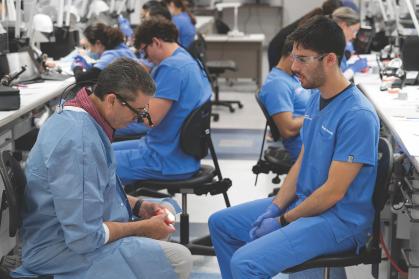
Pre-clinical education closely simulates real-world practice. Students have 24/7 access to practice procedures on mannequins, learn patient communication from faculty, get exposed to treatment planning, and transition from traditional methods to digital dentistry as they progress. Faculty rotate through the pre-clinic.

Towards the end of their second year, students begin assisting third- and fourth-year students at the clinic and get a “big”—an upper-class student mentor. This early exposure to clinical simulation and mentorship lays the groundwork for students, who enter their third year equipped with technical skills and confidence as they get their own patients to treat under the close supervision of RSDM faculty. “We get to develop a rapport with the students early on and track their progress across the four years,” said Lapine.
“We are probably one of the most demanding clinical programs in the country,” said Senior Associate Dean Office for Clinical Affairs Michael Conte ’92, overseeing the school’s clinical operations for two decades. “We have high expectations of our students, and we provide them with patients to meet those numbers.”
With 420 operatories, RSDM’s clinics are bustling, state-of-the-art facilities that operate year-round. Behind the scenes, a complex system of sterilization, supply management, and scheduling keeps everything running smoothly. “The key to this is the people who work here; the dental school employees are what make this a dental home,” Conte said. “We remain a very strong, viable program because of our reputation and have plenty of patients walking through our doors.”
That trust extends far beyond New Jersey. While most patients come from the tri-state area, some travel from as far as Detroit, Florida, and Texas for the kind of holistic care RSDM provides. Assistant Professor of Restorative Dentistry Samantha Wolff, a former New York University faculty and alumna, was struck by the complexity of cases and quality of care at RSDM. “One of the things I love about how Rutgers treats patients is the continuity of care,” she said. “The same student will help work on a case even if a patient is referred to a specialty clinic.” In most institutions, pre-doctoral students do not follow their patients into a specialty clinic.
Peter Henein ’18’23 has been on the side of both pre-doctoral and specialty clinics as he completed his DMD and then returned for his oral and maxillofacial surgery specialty training. “I knew from speaking to friends at other dental schools that Rutgers was a school that gave you a lot of practical hands-on experience,” he said. During his pre-doctoral training, he fell in love with oral surgery during rotations. “The patient volume and the types of procedures that we do are some of the best in the country,” he said. “I did so many implants, wisdom teeth, and trauma orthognathic surgeries in residency that going into private practice was very easy.” He also found mentors who not only taught dental procedures but also skills for a dental professional like how to manage time and have a work-life balance.
Milan Patel ’16, a general dentist and solo practitioner, was drawn to the school because of its clinical program, too. “I was really impressed with just how everybody said that their clinical experience was towards the forefront,” he said. After graduation, he began a general practice residency (GPR) program where he was with a classmate and two graduates from other institutions. He saw RSDM’s clinical difference first-hand.
“We were definitely much more prepared,” he said. “We did 20 crowns prior to graduating, they did five. We did 12 dentures, they did one; so we hit the ground running, and we were doing things that they were still honing in on.”


